
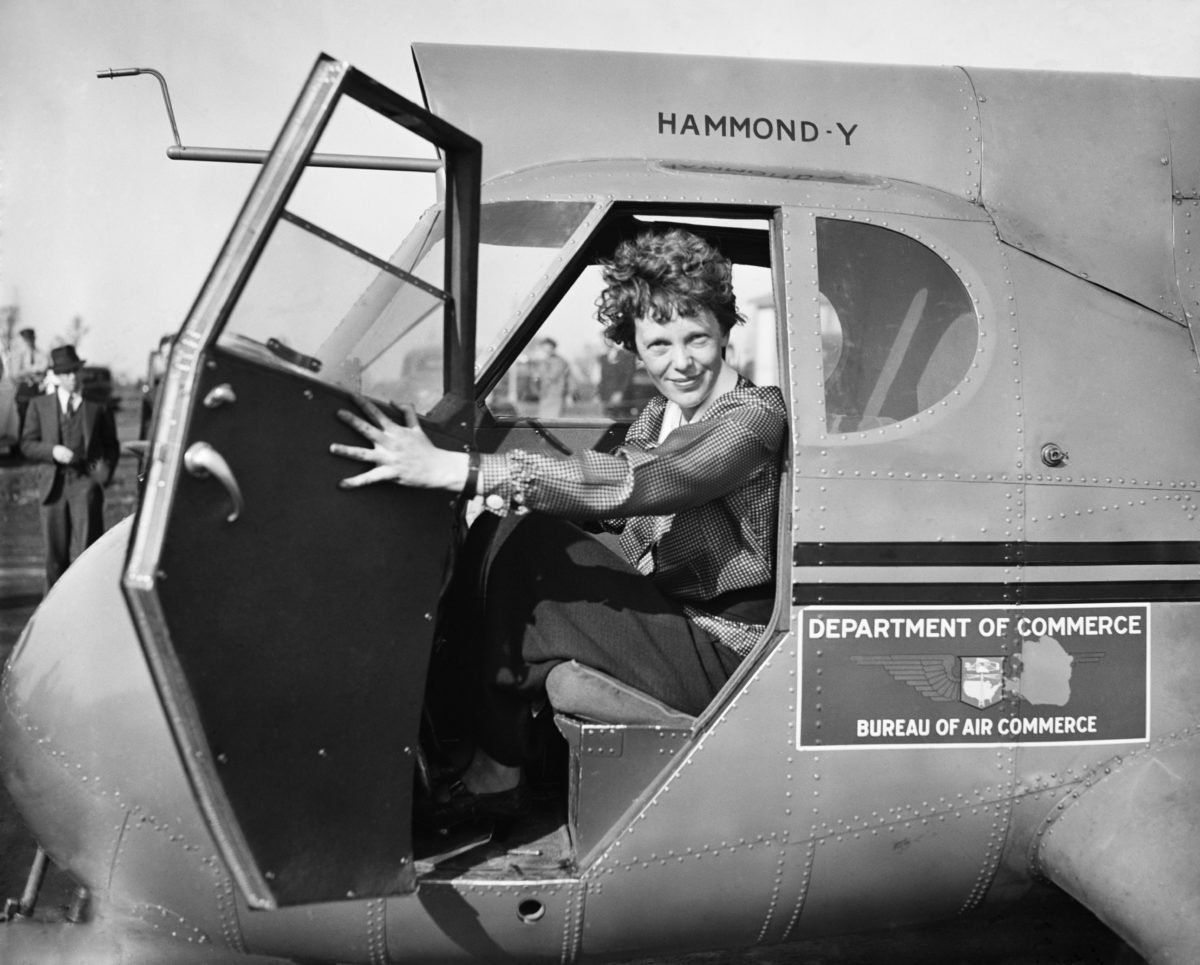
Editor’s Word
Most of us know one thing about Amelia Earhart’s ill-fated story, and her try to change into the primary girl to fly world wide. This text investigates the function extreme dehydration might have performed in her dying and the way it possible supplies a clue into the placement of her lacking plane.
Introduction
Since Amelia Earhart’s disappearance on July 2, 1937, the future of this famed aviatrix continues to captivate each public and scientific consideration. Latest triangulation and a mix of quite a few information factors from a number of scientific disciplines primarily compiled by The Worldwide Group for Historic Plane Restoration (TIGHAR) have now allowed a fairly correct reconstruction of the occasions (7-48) which led to Earhart’s disappearance and her presumed dying (15-17) on Gardner Island (renamed Nikumaroro Island in 1979), possible by issues of extreme dehydration.
Nonetheless, “smoking gun proof” – discovery of the remnants of her airplane (Lockheed Electra 10E Particular, NR16020) or DNA from her suspected bones (15-17) has continued to be elusive. Consequently, the destiny of Earhart remains to be debated regardless of the overwhelming information gathered by TIGHAR, Richard Gillespie (the chief director of TIGHAR), The Nationwide Geographic Society, Richard Jantz, Ph.D. (Division of Anthropology, College of Tennessee,) and others (7-48), demonstrating that Earhart and her navigator, Fred Noonan, had been pressured to land their airplane on Gardner Island after which possible died there as castaways.
Amelia Earhart’s World Encircling Flight Makes an attempt
Amelia Earhart started her first flight meaning to encircle the earth at or close to the equator on March 17, 1937, from Oakland California. Her plan was to initially fly her Lockheed Electra airplane westward to Hawaii, then relaxation and refuel and head off in the direction of distant Howland Island within the Central Pacific, midway between Hawaii and Lae, New Guinea. All through the record-setting try, Earhart deliberate to stay within the left seat which was earmarked for the captain in command. The proper-hand seat was reserved for Noonan, who moreover was a skilled pilot. Nonetheless, Noonan’s main obligation was to function the navigator, therefore he often sat at a small desk positioned within the stern of the airplane, simply reverse the primary entrance door (21) to calculate their bearings and different flight parameters. Earhart’s trans-global equatorial flight represented neither an official U.S. governmental or army mission, however relatively a private endeavor to advertise her profession in addition to that of all feminine aviators.
After touchdown at Luke Area (NAS Ford Island), in Honolulu, Hawaii, Earhart and Noonan rested, refueled, after which took off on the morning of March 20, 1937 for remoted Howland Island 1,900 miles to the west. Sadly, Earhart misplaced management of the Electra whereas touring down the runway at Luke Area and obtained right into a sideways loop which snapped off the fitting (starboard) entrance touchdown gear and tire of the plane. Neither Earhart nor Noonan was considerably damage on this crash, however the Electra was severely broken and was subsequently loaded upon a ship for return to the U.S. mainland for restore. So ended Earhart’s and Noonan’s first world circum-equatorial flight try.
By no means a quitter, the tremendously self-confident Amelia, together with her newly repaired Lockheed, took off once more on her second world equatorial flight try from Oakland to Burbank, California, on Might 20, 1937. From Burbank she flew to Tucson, Arizona, after which to New Orleans and onto Miami, Florida, the place she introduced to the world her transglobal equatorial flight try.
On June 1, 1937, she left Miami and the U.S. for San Juan, Puerto Rico, thus starting the international portion of her worldwide flight world wide. Noonan, as soon as once more, acted as navigator. Due to altering prevailing climate patterns, Earhart’s second around-the-world try pressured her to comply with extra favorable seasonal winds flowing from west to east. The pilot and her navigator encountered few critical mechanical issues (22) as they flew southeastward from Miami to South America, after which onto Africa, India, and Southeast Asia, in the end arriving 22,000 miles away at Lae, New Guinea on June 29, 1937 (22).
However the flight to Lae was not totally with out incident as instrument malfunctions (difficulties with the Cambridge exhaust fuel analyzer) occurred from June 24 to June 26 (22). Extra ominously, the airplane’s Bendix route discovering coupler used with the Western Electrical 20B radio receiver failed its direction-finding check in Lae on July 1 (22), the day earlier than Earhart and Noonan’s departure from Lae to Howland Island. This failure and different radio difficulties would in the end influence her effort to find Howland Island (38).
The following leg from Lae, New Guinea, to Howland Island would signify the longest and most harmful step within the try (7, 22). Earhart and Noonan departed from Lea at 10 a.m. on the morning of July 2, 1937. This leg was fairly dangerous as a result of the meant touchdown place, Howland Island, was so small (1.5 miles in size and Zero.5 miles in width, comprising solely 640 acres) that it could require beautiful navigational expertise to find, significantly after a fatiguing 19-hour, 2,556-mile journey that crossed the Worldwide Dateline.
Amelia Earhart’s Disappearance
A number of years earlier, through the mid-1930s, floor was cleared for a rudimentary plane touchdown space at Howland Island in anticipation that the small landmass would possibly ultimately change into a stopover for business trans-Pacific air routes. The U.S. Bureau of Air Commerce constructed three graded, unpaved runways on the island to accommodate these targets, in addition to to permit Earhart’s twin-engine Lockheed to land throughout her 1937 flight.
On the time, Earhart had change into such a common movie star and darling of the worldwide press (to not point out well-known personalities similar to Eleanor Roosevelt), that her file flight makes an attempt had been worldwide spectacles. Accordingly, few U.S. taxpayers complained when the U.S. Coast Guard cutter Itasca was despatched to Howland Island. There, it moored offshore to watch the upcoming radio voice alerts from Earhart and assist information her and Noonan to the Island. Word that in Earhart’s worldwide flight try, in addition to the cutter Itasca, a small group of naval radio dispatchers had been additionally doubly positioned on Howland Island itself.
Following her departure from Lae, New Guinea, at 10 a.m., Earhart checked in with radio dispatchers at Lae on one-hour intervals. A place report obtained at Lae in a while July 2 indicated that the flight was heading in the right direction and on schedule (7, 22). Nonetheless, the radios on the Lockheed Electra (a Western Electrical Mannequin 13C radio transmitter and a Mannequin 20 B receiver) had been solely designed for a spread of some hundred miles (13). Accordingly, when Earhart ultimately flew outdoors the vary of Lae radio reception, her plan was to synchronize her one-hour broadcasts with the Itasca Coast Guard cutter’s radio reception and transmitter alerts as she approached Howland Island (38). Moreover, Itasca was to ship visible smokestack alerts to the airborne Electra as soon as they knew it was in vary.
Sadly, as soon as Earhart was out of Lae’s radio vary, communication breakdown commenced, and Earhart’s and Noonan’s paths to disaster had been sealed (38). Along with her world flights, radio transmissions between Earhart and others had been restricted from different plane, and had been particularly reserved for 3 frequencies: 3105 kHz alerts for nighttime transmissions, 6210 kHz for daytime transmissions, and 500 kHz to facilitate oceanic and emergency transmissions (13, 23). A needed exception was the Itasca, anchored off the coast of Howland Island; the cutter was given the freedom to make radio transmissions to Earhart on the reserved frequencies (13). For all different short-wave radio station listeners, they clearly may listen in on her main frequencies, 3105 kHz and 6210 kHz, however had been requested to not make transmissions (13).
Disastrously, the Itasca radio dispatchers one way or the other couldn’t transmit any radio transmissions that might be obtained by Earhart; they might solely obtain her radio transmissions (38). Accordingly, Earhart and Noonan would have been flying to Howland Island with out the help of the Itasca’s radio transmissions, in addition to with out assistance from their airplane’s Bendix radio route discovering coupler (22, 38).
Earhart’s plane left Lae loaded with 1,090 gallons of aviation gasoline, which was near the airplane’s capability of 1,151 gallons (21). Amelia’s engineering crew calculated that this gasoline load would give her Electra’s two Pratt and Whitney R-1340 S3H1 Wasp engines maximal distance efficiency as she flew eastward in the direction of her vacation spot of Howland Island, 2,556 miles away.
Itasca’s radio log recorded a number of transmissions from Earhart as she flew in vary of Howland Island. The primary necessary name got here in at 7:42 a.m. Howland Island native time, which corresponded to eight:42 a.m. Gardner Island native time. Earhart’s broadcast on 3105 kHz was: “We have to be on you however can not see you. Gasoline is operating low. Been unable to achieve you by radio. We’re flying at 1,000 ft.”
Whereas she was nonetheless within the air, the final transcribed message that the Itasca obtained from Earhart was, “We’re on the road 157/337. We repeat this message on 6210 kilocycles.” This communication was despatched at Eight:25 a.m. Howland Island time and correspondingly at 9:25 a.m. Gardner Island native time (14).
The message, “We’re on the road 157/337,” was to point out the Itasca radio dispatchers the route Earhart and Noonan had been following as they tried to find Howland Island. “We’re on the road 157/337” refers to “The Line of Place” (LOP), an 18th century nautical approach combining angle of commentary of a celestial physique (the rising solar, on this case, for Noonan) with an actual time of day to find out location (25, 26). Overcast circumstances had prevented Noonan from utilizing celestial navigation in a single day, so he needed to depend upon the solar’s rising place as he approached Howland Island (25). Accordingly, Noonan’s bodily place within the airplane at dawn was within the stern of the airplane the place he may view the rising solar together with his bubble octant from the 2 particular home windows put in port and starboard in entrance of the rest room and fundamental entrance to the airplane (27).
The Itasca radio dispatchers, upon listening to Earhart’s radio transmissions, had been helplessly unable to achieve out to her with counter transmissions to assist information her to Howland Island due to varied radio issues between the 2 (38). One other tiny island, Baker Island, lies about 43 miles instantly south or barely southeast of Howland Island, however Earhart’s radio transmissions on the anticipated time of arrival on Howland indicated that they noticed no land under their plane.
Taken collectively, these information point out that Noonan and Earhart in all probability thought they’d crossed the Howland Island LOP to the north of its precise place, once they had been in all probability about 100 to 135 miles southwest of Howland (11). As soon as they realized that their vacation spot was nowhere to be visually decided at its calculated LOP, they needed to decide to fly alongside the 157/337 LOP in both a north-northwest or south-southeast route (or each) as their dwindling fuel reserves ran out. Gardner Island usually lies upon the 157/337 LOP within the south-southeast route from Howland Island. So, it’s obvious that Amelia Earhart and Fred Noonan in the end determined to fly on a south-southeast course (25, 26) that will ultimately lead to each of their deaths as castaways after touchdown at Gardner Island.
Arrival on Gardner Island (Renamed Nikumaroro Island in 1979)
As Earhart and Noonan approached Gardner Island, they flew in from the northwest usually alongside the 157/337 LOP, possible flying at 1,000 ft. With minimal gasoline provides, and an estimated cruising velocity between 100 to 150 mph (20), they sighted Gardner Island and certain made a go or two at low altitude across the island earlier than Earhart selected their touchdown space on the coral reef. Therefore, whereas nonetheless within the air they undoubtedly had been capable of learn the identify on the aspect of a wrecked freighter that ran aground on the northwest nook of the reef on November 29, 1929 (36) (Figures 1, 2). The freighter’s identify, “Norwich Metropolis”, was painted in daring white
Determine 1. The freighter SS Norwich Metropolis docked on the Burrard Drydock Firm in Vancouver, British Columbia, on April 27, 1928. Picture by Lindsay Loutet
Determine 2. Norwich Metropolis wreck on Gardner Island (1937) with bow of ship dealing with northeast. Picture by Eric Bevington (1937) courtesy of TIGHAR. Forensic imaging by Jeff Glickman of Photek, Woodinville, Washington.
letters on the port aspect of the northeast dealing with bow of the wrecked ship, which might be instantly viewable to a circling airplane to the west of the ship (Figures 1, 2) (28, 36). The out there information signifies the white lettering survived the hearth that engulfed the ship after its wreck in 1929 and was nonetheless seen in 1944 (36).
The prompt touchdown velocity for the Electra Mannequin 10 A (and Mannequin 10E NR16020) at sea degree (with flaps) is 63 to 65 mph (29, 37), and the estimated stopping distance was 1,000 to 2,500 ft (34, 37). The stopping distance for the Lockheed L10 on a dry floor has been estimated to be 1,000 ft; that distance extends to 1,350 ft for moist grass and a couple of,500 ft for moist concrete or ice (37).
Earhart’s final transmission to the Itasca, “We’re on the road 157/337” occurred at 9:25 a.m. Gardner Island time (14). A vital incontrovertible fact that was not initially thought of by investigators till years after Earhart and Noonan had been misplaced, was the tidal ebb and stream on Gardner Island on the morning of July 2, 1937 (14, 20). And not using a low tide, Earhart couldn’t have safely landed her plane upon the coral reef at Gardner Island (14, 20). Luckily, tides had been low and, thus, touchdown was doable throughout that individual morning (14, 20). Under is an evaluation of that arrival window based mostly upon tidal ebb and stream.
“The message accommodates no point out of an island in sight, so the plane was not but in visible vary of Gardner. The earliest the plane may fairly arrive is subsequently roughly 9:45 a.m. At the moment the reef is dry, however the tide is coming in. Based mostly upon the plane’s touchdown velocity and tire dimension, the water degree on the reef have to be not more than 6 inches (.15m) for a secure touchdown. The arrival window closes at about 11:30 a.m.” (14).
Precisely the place on Gardner Island Earhart and Noonan landed their Lockheed is at the moment conjectured (14, 18) however shouldn’t be recognized with certainty (14, 18, 35, 46). Moreover, Noonan possible suffered critical or life-threatening accidents through the touchdown at Gardner Island (14). Each occasions have necessary implications for the interpretation of “What actually occurred to Amelia Earhart?”
Radio Transmission Proof for Gardner Island Touchdown
Early on the afternoon of July 2, 1937, the U.S. Navy Hydrographic Workplace in San Francisco put out an “all ships, all stations” communiqué asserting that the Earhart airplane had didn’t arrive at Howland Island and was assumed down at sea (13). As a result of it was presumed that the airplane may transmit alerts if afloat, the Navy requested all related radio receivers to take heed to Earhart’s main frequencies of 3105 kHz and 6210 kHz (13). After the pair had been assumed to be “down at sea,” all subsequent radio alerts from the plane have been known as “Publish-Loss Radio Alerts” (13). Sadly, the official report by the Itasca’s commanding officer, Warner Thompson, had dismissed all of the “Publish-Loss Radio Alerts” and concluded, it was “extraordinarily uncertain that Earhart ever despatched alerts after 0846 (sic), 2 July” (24).
This official conclusion flies within the face of latest analyses of the 57 credible, past a shadow of a doubt (CBRD) radio transmissions made by Earhart and Noonan after their final in-flight transmission to the Itasca on July 2, 1937 (14, 20). Earhart and Noonan’s “submit loss” transmissions on their main frequencies (3105 and 6210 kHz) had been heard by U.S. authorities or skilled business radio operators together with: 1) the U.S. Navy; 2) the U.S. Coast Guard; Three) Royal Navy radiomen aboard ships; Four) U.S. Navy Radio, Wailupe, Hawaii; Four) Navy Radio Tutuila; 5) American Samoa; 6) U.S. Coast Guard Headquarters, Honolulu, Hawaii; 7) licensed amateurs of the U.S. Division of Inside on Howland and Baker Islands; Eight) Pan American Airways radio route discovering stations on Oahu, Halfway, and Wake Islands; 9) and the Amalgamated Wi-fi station on Nauru Island (13). This information unequivocally demonstrates that Earhart’s airplane landed on strong floor and was capable of make radio transmissions for a six-day interval from July 2, 1937 to July 7, 1937 (14, 20).
Extra importantly, 4 technologically superior radio receivers positioned within the Pacific Ocean area in 1937 (Wake Island, Halfway Island, Mokapu Level on Oahu, Hawaii, and Howland Island) had the power to find out the radio transmission beam angle bearings of Earhart’s reserved frequencies (3105 kHz and 6210 kHz) (13, 30). Of the seven credible “post-loss” transmissions detected by the 4 superior radio receivers, 5 triangulate Earhart’s place to the fast neighborhood of Gardner Island (13, 30). This information supplies compelling proof that Earhart and Noonan landed their Lockheed on Gardner Island (13, 30) and had been capable of make nightly low tide (14, 20) radio transmissions throughout that six-day interval (13, 30).
The radio transmitter on Earhart’s airplane was instantly positioned under Noonan’s small navigational desk within the stern of the airplane, in entrance of the airplane’s bathroom and bathroom house (27, 30). Nonetheless, Earhart keyed the radio transmitter from a mouthpiece microphone within the airplane’s cockpit. Noonan had two positions within the airplane the place he would have been sitting: 1) the right-hand cockpit seat, or 2) on the navigational desk within the stern of the plane. If Noonan had been positioned on the navigational desk and needed to enter the cockpit, he would have needed to climb over the six 754-gallon auxiliary tanks (21) put in within the Electra on the center of the fuselage. As you possibly can see from this photograph (Determine Three), the maneuver required to go from
Determine Three. The six 754-gallon auxiliary fuel tanks separating the cockpit from the strict of the airplane.
the place Noonan positioned himself – as both the navigator within the stern of the airplane or within the right-hand cockpit seat as Earhart landed upon Gardner Island. Simply as Earhart’s left-hand captain’s seat, the right-hand cockpit seat had lap belts, however no shoulder harnesses. The navigator place within the stern of the airplane had no recognized everlasting seats or restraints.
The Six-Day Interval (July 2 to July 7) on Gardner Island and Past
The Touchdown and Noonan’s Critical Accidents
The pressured touchdown at Gardner Island possible was tough, bumpy, and violent because the airplane touched down on the coral reef at an estimated touchdown velocity of 63-65 mph (29, 37). Noonan nearly definitely suffered critical and/or life-threatening accidents upon touchdown at Gardner Island based mostly upon “post-loss” alerts obtained worldwide (14). TIGHAR signifies that modern inspections of the coral reef at Nikumaroro exhibit that “the coral nearer to shore is jagged, slippery, pitted and at all times lined with a number of inches or extra of water.” (13).
If Noonan was positioned within the stern of the plane, he would have had no lap belt restraints. Upon touchdown he might have skilled violent bumps and fast decelerations that might have slammed his head and physique into the six 754-gallon fuel tanks separating the cockpit from the strict of the airplane or elsewhere. Alternatively, he might have suffered his critical accidents (14) whereas sitting within the right-hand cockpit seat upon touchdown as his head and chest careened into the cockpit sprint panel throughout fast decelerations that will have occurred.
In addition to the 2 main radio frequencies (3105 kHz and 6210 kHz) Earhart used to broadcast her transmissions from Gardner Island, she unknowingly was transmitting different radio frequencies. Radio transmitters of that period often utilized digital circuit designs that produced harmonics (multiples) of the 2 main radio frequencies that Earhart transmitted. Excessive harmonic frequencies “skip off the ionosphere and will journey nice distances, nonetheless clear reception is erratic and changeable (13).” Nonetheless, Amelia’s erratic harmonic transmissions from Gardner Island had been heard globally (14).
On July 2, a CBRD radio transmission by Amelia at 9:00 p.m. Gardner Island time was heard by Mabel Larremore in Austin, Texas, saying that Noonan was “critically injured” and “wanted assist instantly.” Earhart said she had “some accidents however not as critical as Mr. Noonan’s” (14). A person’s voice was heard in a number of credible messages on July Three and Four, suggesting that Noonan, though injured, was not less than lucid. By July 5, Noonan’s situation had deteriorated (14). Betty Klenck, a 15-year-old teenager from St. Petersburg, Florida, was listening on her household’s shortwave radio which was hooked up to a protracted wire antenna when she heard Earhart’s determined CBRD radio transmissions for assist. She transcribed the messages she heard into her pocket book. In Klenck’s transcription, Earhart appears to be in ache from what might have been an ankle damage (misheard as “uncle”) (14). Noonan, nonetheless, was delirious and panicky. The character of his damage is nowhere talked about, however Klenck thought he might have struck his head (14). Two days later (July 7), Thelma Lovelace of St. Johns, New Brunswick, hears the next CBRD radio transmission, “Are you able to learn me? Are you able to learn me? That is Amelia Earhart. That is Amelia Earhart. Please are available in. We now have taken in water; my navigator is badly damage; my navigator is badly damage; we’re in want of medical care and will need to have assist; we will’t maintain on for much longer” (14).
The Touchdown Space on Gardner Island
Earhart’s regular cruising velocity and altitude within the Lockheed Electra was 150 mph (21) and between Eight,000 and 10,000 ft (21). Nonetheless, as she approached Howland Island, she indicated that her cruising altitude had been diminished to 1,000 ft to higher visually find the island under the clouds. She was additionally operating low on gasoline, so she might have diminished her regular cruising velocity to an estimated 100 to 130 mph (20) as she flew alongside the 157/337 LOP. Earhart possible made one or two low altitude visible passes of Gardner Island earlier than deciding upon essentially the most risk-free touchdown space on the coral reef. Determine Four under exhibits a map of Nikumaroro Island.
Determine Four. Map of Nikumaroro Island (previously often known as Gardner Island)
Just a few key information and websites on the island ought to be identified. The island is a coral atoll with a central lagoon and is roughly Four.7 miles lengthy and 1.6 miles extensive. The island has been briefly inhabited on and off from 1892 till 1963 however has perpetually didn’t thrive due to periodic droughts and an unstable freshwater lens (a convex reservoir of freshwater that floats above the denser saltwater and is recharged by rainwater). When Earhart and Noonan arrived on July 2, 1937, the island was uninhabited, as it’s now and has been since 1963-’64.
The Dehydration Clock Begins Ticking
People can survive for 4 to 6 weeks with out meals, however with out water we quickly dehydrate and die from life threatening physiological issues of dehydration, usually in about three days (1-6). Deadly dehydration is modulated through quite a few environmental circumstances together with ambient temperature, shade, relative humidity, exercise, age, gender, peak and weight, health ranges, well being, and different components (1-6). Every of those components affect water stability (stability = water ingested – water loss) (1-6). When water losses exceed the water we ingest, dehydration happens. Delicate dehydration corresponds to 1 to 2 % of physique weight reduction in adults and might result in a big impairment in cognitive operate (alertness, focus, brief time period reminiscence) and psychomotor efficiency (Three, 5). Fluid deficits of 4 % lower bodily efficiency, and trigger complications, irritability, sleepiness, and elevated respiratory charges in kids (5). Extreme dehydration happens with larger than eight % or extra weight reduction and is life threatening (5). Accordingly, water represents the only most necessary nutrient that people should often ingest (1-6).
Based mostly upon tidal ebbs and flows, the earliest the Electra may have fairly arrived on Gardner Island was roughly between 9:45 a.m. and 11:30 a.m. on July 2 (14). Therefore, that window of time marks the start of the physiological dehydration occasion that just about definitely contributed to the dying of Earhart and Noonan.
Amelia’s presumed stays (15-17) (Determine 5) had been found in September 1940 at a location on the southeastern finish of Gardner Island, as we speak known as Seven Website (17) (Determine Four), near shore and beneath the shade of a ren tree (Tournefortia argentia) (17).
Determine 5. The 13 bones found at Seven Website on Gardner Island in September 1940 and presumed to be the skeletal stays of Amelia Earhart (15). Determine 5 from (16).
The 13 bones lay scattered upon the bottom’s floor and had been discovered by a working occasion at Gardner Island for the British Phoenix Island Settlement Plan in 1940. Upon discovery of the skeletal stays, the employees dug a gap within the coral rubble and buried the cranium, however not some other bones (15). The British officer in control of the Settlement Plan, Gerald Gallagher, ordered a extra thorough search of the realm and subsequently found all 13 bones depicted in Determine 5 (15, 16).
Throughout the six-day interval that each Earhart and Noonan made their “Publish-Loss” radio transmissions from the Lockheed, they each clearly needed to be current within the Electra throughout their nightly transmissions (14). To quote TIGHAR:
“We are able to make sure that Earhart and Noonan had been aboard the Electra through the lively durations, and the brand new graphs designate these instances. We are able to additionally make sure that the temperature aboard the steel plane parked within the solar through the day would encourage in search of shade, meals, and water ashore throughout sunlight hours.” (13).
Throughout daytime hours when the tide rose, circumstances had been unimaginable for radio transmissions (13, 20), and the environmental circumstances (ambient temperature and relative humidity) contained in the all-metal airplane would have been excruciating. Consequently, in the event that they had been bodily ready to take action, Earhart and Noonan would have sought shade on shore throughout excessive tide and sunlight hours. Then, at night time, they’d have returned to the airplane throughout decrease tides and cooler temperatures (13, 20) to make radio transmissions (14), which had been their solely hope of rescue.
Due to Noonan’s life-threatening accidents (14), he might not have been capable of climb out of the airplane and stroll to Seven Website, the place Earhart’s presumed stays had been discovered (15-17). As beforehand famous, Noonan’s voice was lucid on July Three and Four, however by the July 5 post-loss transmission (14) his situation had deteriorated and was described as “delirious and panicky” (14). His situation is no surprise, on condition that he was now possible on his third day with out ample water, along with any bodily trauma he might have suffered through the touchdown. Two days later, on July 7 at 1:30 a.m., Thelma Lovelace heard Earhart say, “We now have taken in water, my navigator is badly damage; my navigator is badly damage; we’re in want of medical care and will need to have assist; we will’t maintain on for much longer.” Noonan was now possible six days with out ample water and was in all probability close to dying from extreme dehydration. It appears obvious that he not had the energy to climb out of the Electra and stroll to their shoreline campsite at Seven Website.
When Earhart and Noonan touched down on Gardner Island on the morning of July 2, 1937, they might not have recognized their precise location by latitude and longitude. The one distinguishing function of the Island was the identify “Norwich Metropolis” on the shipwreck on the northwest nook of the island (36) (Figures 1, 2) which they possible noticed as they circled the island in search of a secure touchdown space on the atoll. Each Earhart and Noonan clearly realized that their solely probability of rescue from this uninhabited island could be to radio their location to the skin world. After dusk on their first day’s existence on Gardner island, Noonan nearly definitely decided their latitude and longitude, through celestial navigation, utilizing his bubble octant. Earhart broadcast this data (latitude and longitude) to all worldwide listeners (14). Their location was heard on a number of events by listeners Mabel Larremore on July 2, by Dana Randolph on July Four, and by Betty Klenck on July 5 (14). Sadly, the latitude and longitude coordinates haven’t survived (14). As a result of Noonan possible didn’t have a chart aboard the Electra which may present the identify of Gardner Island (14, 39), Earhart’s solely recourse on her radio transmissions was to present her latitude and longitude and the distinguishing identify of the island’s shipwreck “Norwich Metropolis.” Klenck repeatedly heard Earhart saying one thing that gave the impression of “New York Metropolis” (39) which possible through erratic harmonic distortions really might have been “Norwich Metropolis” indicating the attribute shipwreck on the island.
No ambient day and nighttime temperatures or environmental information exist for Gardner Island from July 2, 1937 to July 7, 1937. The island was uninhabited with out a climate station. Nonetheless, historic and newer data from close by inhabited islands within the South and Central Pacific can present affordable estimates of the environmental circumstances that the pair would have confronted after touchdown on Gardner Island. From July 2, 1937 till July 16, 1937 the estimated common excessive temperature on Gardner Island possible was 85 °F and the typical low temperature possible was 74 °F. The estimated imply 24-hour relative humidity possible was between 75 to 80 %, and the estimated common day by day rainfall in July possible was Zero.08 inches. These estimated environmental circumstances clearly result in unfavourable complete physique water balances (water stability = water ingested – water loss) in people and consequently progressive dehydration until recent water is ingested (1-6).
No data exist of the meals and water that Earhart and Noonan carried aboard the Electra for his or her anticipated 19-hour flight from Lae, New Guinea to Howland Island, however Earhart most popular touring mild. In a Heinz Radio interview performed between 1935 and 1937 (43), she stated “Tomato juice is my favourite ‘working’ beverage, and meals too. In colder climate, it could be heated and stored sizzling in a thermos.” (40, 43). Her thermos of alternative was a Stanley Tremendous Vac Thermos (roughly one-quart capability), manufactured between 1930 and 1935 and utilized by the well-known Australian aviatrix Nancy Chicken Walton (41) (Determine 6).
Calvin Pitts introduced Amelia’s precise Stanley Tremendous Vac Thermos with him on his profitable world flight in 1981 (42) (Determine 7).
Determine 6. Amelia Earhart introduced a Stanley Tremendous Vac Thermos, similar to the one pictured under, on her solo Atlantic Crossing in 1932.
Determine 7. Calvin Pitts holding Amelia’s Earhart’s precise thermos from her solo Atlantic Crossing in 1932 throughout his profitable world flight in 1981 (42).
Earhart additional indicated that her in-flight menu was decided by three guidelines (40).
The primary, she stated, was to be fed sufficient to “stop fatigue however not sufficient to induce drowsiness” (43). The second was that the meals needed to be one thing that she may eat simply. “Since pilots have solely two fingers and dozens of issues to do, mealtime approach needs to be easy,” she defined. “So I’ve developed a gadget, which is mostly a fats ice choose. With the can between my knees, one-handed, I punch a gap within the high. A straw simply matches the opening — and the remaining is straightforward” (43).
“Flying the Atlantic — a journey of 16 hours from New Foundland (sic) to Eire — my menu outdoors of tomato juice was restricted to a couple squares of chocolate. It was relatively a troublesome night time leaving me with out time or inclination to be hungry. On my solo flight from Mexico Metropolis to New York my mainstay was a hardboiled egg (43).”
“Typically sizzling cocoa dietary supplements tomato juice. Candy chocolate and infrequently raisins are stimulating too” (43).
Human style buds can detect 5 sensations: candy, bitter, bitter, salty, and umami. Just lately, it has been demonstrated that the umami sensation is enhanced in loud environments (>85 dB) similar to plane cabins (49, 50) whereas sweetness is depressed (49, 50). Therefore, Earhart’s urge for food for tomato juice on lengthy (~15 hour) flights might have stemmed from her enhanced umami, induced by loud cockpit environments (49, 50).
Earhart’s third rule concerning vitamin and aeronautical flight needed to do with weight. She was obsessive about the load of her plane. She carried as little aboard as doable — a handkerchief, a tube of chilly cream, tomato juice — to permit for extra gasoline (40). As she advised her husband and supervisor, George Putnam, “My concern was merely to fly alone to Europe. Additional garments and additional meals would have been further weight and additional fear. A pilot whose aircraft falls into the Atlantic shouldn’t be consoled by caviar sandwiches.” (40).
Taken collectively, the previous data signifies that Earhart and Noonan had made little or no provisions for a touchdown of their plane which might strand them with out meals or water. Based mostly upon their lack of preparations, they merely assumed that they’d arrive safely at every vacation spot on their world circumnavigational flight. The out there proof signifies their solely liquid/water supply onboard the Electra would have been from tomato juice (possible 32-ounce (one-quart) capability cans, based mostly upon 1937 ads) and the contents of the one-quart Stanley Tremendous Vac Thermos. Accordingly, if Earhart’s liquid reserves had been one 32-ounce (Zero.946 liters) can of tomato juice and a single one-quart (Zero.946 liters) thermos, then her complete water on board would have amounted to barely lower than 1.89 liters. If Noonan had comparable liquid provides as Earhart, then the full water on board the Electra would have been barely lower than Three.78 liters. If they’d have doubled this amount, then their on-board water provides had been considerably lower than 7.56 liters. Sedentary adults ought to drink 1.5 liters of water per day (Three) and optimally > 1.Eight liters per day to stop dehydration (1). Accordingly, with their maximal estimated-on board liquid provides, the pair would have exhausted all plane water shops by about July 5, 1937.
The physiological dehydration window started ticking someplace between 9:45 a.m. and 11:30 a.m. on July 2, 1937 and in the end contributed to each of their deaths. The typical size of time that people can exist with out water is about three days (1-6). The July environmental circumstances current at Gardner Island would have accelerated Amelia and Fred’s dehydration state (1-6). Accordingly, they’d be reaching their three-day deadly dehydration limits by the morning of July 5, 1937 if they’d no entry to recent water. The out there proof (40, 43) means that on board juice and water provides would have prolonged their dehydration limits barely past July 5, and certainly the ultimate “post-loss” radio transmission occurred on July 7 (14).
False Alarms: Tessie and the Bevington Object
A vital resolution pilots should make in pressured touchdown conditions is to take care of sufficient unobstructed taxi distance given the airplane’s cruising velocity and recognized secure landing velocity. As she approached Gardner Island, it’s estimated that Earhart’s cruising velocity was between 100 and 130 mph (20), and her landing velocity possible was between 63-65 mph (29, 37). Provided that landing velocity, her regular touchdown distance would have been between 1,000 and a couple of,500 ft (34, 37). On Gardner Island, the longest and most secure unobstructed touchdown space was the coral atoll at low tide on the jap aspect of the island which represents a close to straightaway distance of Four.7 miles with no lagoon inlets, shipwrecks, or different obstacles (Determine 2). Earhart, flying in from the north, would have had greater than sufficient time to scale back her cruising velocity to the Electra’s really useful touchdown velocity and nonetheless have had greater than ample distance to make a touchdown on the jap aspect of the island. In distinction, the western aspect of the island was interrupted by two inlets into the lagoon, a non-linear shoreline (Determine Four), and its northwest finish was interrupted by a big shipwreck. Given these circumstances, the jap aspect of the island possible visually represented the safer touchdown space.
Thom Boughton, an skilled air visitors controller on the U.S. Federal Aviation Administration and former flight teacher at Kent State College had this to say about Amelia Earhart’s resolution to land on Gardner Island:
“Little question she did what anybody in that state of affairs has ever finished: she discovered what the longest, widest, smoothest, and dryest (sic). Every part else… be damned. You are worried about that later.” (44)
Ric Gillespie, the chief director of TIGHAR responds to Thom Boughton’s feedback:
“Properly put Thom. Having been in a number of conditions the place I’ve needed to ponder an emergency touchdown, I’ve to agree. If you’re left with no possibility apart from an ending the flight proper now, the primary and solely consideration is security.” (44)
Each Boughton and Gillespie are in obvious settlement that the “longest” right away touchdown space on Gardner Island’s coral atoll could be the most secure. Clearly the jap aspect of Gardner Island is superior to the western aspect of the island on this regard (Determine Four).
In distinction, the generally speculated (Determine Four) location for Earhart’s and Noonan’s touchdown space shouldn’t be on the jap aspect of the island, however relatively on the western aspect about 400 meters north of the wreck of the Norwich Metropolis (13). Moreover, if the Electra would had flown in from the north, then Google Maps exhibits that this touchdown technique on Gardner Island offers Earhart and Noonan a naked minimal distance (~1,400 ft) on a moist, slippery coral reef to accommodate the estimated touchdown distance of 1,350 to 2,500 ft (37). Clearly, a safer flight plan could be the Four.7-mile flight route on the jap aspect of the island, touchdown from north to south.
The bias for the plane touchdown web site on the northwest space of the island comes from an obscure object detected in a single photograph made by Eric Bevington in October 1937, three months after Earhart’s plane disappeared. Bevington was touring with a British and Gilbertese Island group to find out which of the distant Phoenix islands is perhaps appropriate for colonization and settlement. Whereas on Gardner Island from October 13-15, Bevington took a 2.5 by Three.5 picture displaying the SS Norwich Metropolis shipwreck containing a microscopic dot of an upright object to the left of the shipwreck (Determine 2). Initially, after its discovery and recognition in 2010, the item was named “Nessie” after the Loch Ness Monster however later known as the “Bevington Object” which Jeff Glickman of Phototek Forensic Imaging in Woodinville, Washington, prompt was the touchdown gear and tire from Earhart’s Lockheed Electra Plane (18).
A senior picture analyst from the Imagery Middle on the U.S. State Division Bureau of Intelligence and Analysis unofficially examined the picture containing the “Bevington Object.” He was cautious together with his evaluation as a result of the picture got here from a print and never from the unique unfavourable. Moreover, what puzzled the senior analyst was that the meeting appeared to be not solely broken however the other way up.
He stated: “The gear can not nonetheless be hooked up to the airplane or we’d see extra of the aircraft. If it’s indifferent from the aircraft, why is the heavy aspect up?” (18). He additional stated, “On this enterprise now we have three ranges of certainty – Potential, Possible, Confirmed. That this picture exhibits the touchdown gear of a Lockheed Electra is someplace between Potential and Possible”.
Word that the item was not “Confirmed.”
Further issues with the speculation that the touchdown web site was barely north of the Norwich Metropolis wreck on the coral reef was that no proof of remnants of the Electra have ever been discovered within the waters surrounding the presumed touchdown web site. Robert Ballard, the well-known oceanographer/geologist who found the Titanic and plenty of different shipwrecks, not too long ago (August 2019) returned empty-handed from Nikumaroro after intensive multi-scan sonar analyses together with a deep diving remotely operated automobile (ROV) (35, 46). Ballard stated, “We visually examined 100 % of the island all the way down to 750 meters (2,400 ft) and didn’t see proof of the aircraft. We did 100 % of the first zone visually all the way down to 900 meters (Three,000 ft).” No aircraft! (35). Ballard doesn’t plan to return to Nikumaroro until DNA or different definitive proof is uncovered. Nonetheless, he indicated that if he returns, he would search seashores additional south.
Additional, intensive visible and steel detector land searches of huge areas on shore surrounding the suspected touchdown space on the northwestern a part of the coral atoll have revealed no proof of an Earhart/Noonan campsite (45). In distinction, the Seven Website on the southeastern aspect of the island (Determine Four) has archaeologically uncovered intensive information indicating human castaway occupation through the late 1930s (17). It’s inconceivable that below the extreme dehydration circumstances that Earhart and Noonan suffered from July 2 to July 7 that they’d have walked to a web site some Four.7 miles from their authentic touchdown web site.
Some of the necessary points about Earhart’s specifically modified Electra, which has been briefly addressed, is the buoyancy of her totally flooded plane (47). Thus far, no calculations have been revealed demonstrating the web density of Earhart’s Lockheed Electra 10 E Particular, NR16020 when the cabin was utterly or partially flooded by seawater. Earhart’s all-metal airplane was largely constructed of aluminum, but it surely additionally contained two metal radial, air-cooled engines, different metal elements, varied copper containing elements, and lead batteries, amond different issues. Nonetheless, the mass and density of each part of the plane are usually not required to find out if it could float or sink. Solely the mass of the airplane on land, the residual air quantity within the plane’s empty fuel tanks, the density of the airplane’s main steel (aluminum, density = 2.7 g/cc), the density of seawater, and the underwater mass of the plane are wanted to find out the airplane’s web density when the cabin was utterly flooded (Equation 1).
Equation 1. The estimated density of the Lockheed Electra 10 E Particular, NR16020 because the cabin is both freed from seawater or flooded with seawater.
If the web density of the plane was lower than 1.025 g/cc, it could float. If the web density of the airplane was larger than 1.025 g/cc, it could sink. If the residual air quantity within the fuel tanks was not displaced by flooding seawater, then the plane would float indefinitely. Clearly, this was not the case. The auxiliary fuselage fuel tanks had been vented to the skin through tubes to the highest of the airplane (Determine Three) and will need to have allowed seawater to enter, or alternatively the auxiliary fuselage tanks might have been ruptured upon the touchdown at Gardner Island.
Closing Days and Closing Moments
Taken along with the “post-loss” radio alerts (14), this data factors to a state of affairs wherein the Electra grew to become more and more buoyant and flooded with saltwater after July 7, 1937 and would have ultimately floated away because the July tide progressively rose (14). A usually configured Electra 10 with out Four,357-liter gasoline tanks would sink in saltwater after eight minutes (47). Due to its “tremendous buoyancy” (Equation 1), Earhart’s Electra possible floated significantly longer than eight minutes after the tide dislodged it from its touchdown spot on the coral reef. Accordingly, the plane might have floated out to sea far-off from the shoreline close to the Seven Website location, earlier than seawater ultimately entered the gasoline tanks’ venting tubes and precipitated the web density of the airplane to exceed the density of seawater (1.025 g/cc) and, subsequently, sinking the airplane.
One of the best proof earlier than Earhart disappeared is that this; she was alive and current sporadically within the cockpit of her airplane from July 2, 1937 (6:55 p.m.) to June 7, 1937 (1:30 a.m.) as she made determined radio pleas for assist and help (14). Due to Fred’s critical and life-threatening accidents upon touchdown July 2 at Gardner Island (14), alongside together with his ensuing six-day extreme dehydration, he nearly definitely was “delirious” (14) or comatose and confined to the cabin of the Electra unable to exit the airplane for the shade of the shore on the, Seven Website.
The final CBRD determined transmission from Earhart occurred at 1:30 a.m. on July 7: “We now have taken in water, my navigator is badly damage; my navigator is badly damage; we’re in want of medical care and will need to have assist; we will’t maintain on for much longer” (14). Because the tide rose on the early morning of July 7, and started to lift Earhart’s Electra into the water, this courageous girl nearly definitely deserted her plane to flee the drowning that Noonan definitely confronted as he lay “delirious” (14) within the plane because it floated eastward to the open sea.
No additional radio transmissions had been despatched by Earhart after 1:30 a.m. on July 7, suggesting that the Electra had floated into the ocean someday later that morning, thereby making radio communications unimaginable (14). On the morning of July 9 (~Eight:15 a.m. Gardner native time), three U.S. Navy search planes from the battleship USS Colorado flew over Gardner Island and reported that no plane had been seen (14). This information means that Fred floated out to sea with the Electra and drowned aboard it earlier than July 9, if he had not already died beforehand from dehydration. Earhart, additionally in a severely dehydrated state, escaped to shore and lay down on the Seven Website the place she possible died from dehydration someday between July Eight and July 10.
The Aftermath
One of many key items of (logic/proof) within the Earhart disappearance, which has gone unrecognized, is the connection between the airplane’s touchdown place and the adjoining linkage to an onshore campsite.
Virtually all of the “post-loss” radio transmissions from Juy 2 to July 7 had been despatched by Earhart through the evenings and nights when the tides had been low (14). Clearly through the daytime hours Earhart will need to have left the plane and the next warmth and humidity contained in the all-metal Electra’s cabin and sought shade and cooling temperatures on shore. Accordingly, the info exhibits a predictable nighttime radio transmission scheme that adopted a 12-hour daylight interval (14).
Given this data, Earhart’s airplane’s location and her shoreside campsite location needed to be adjoining to 1 one other (from a time and distance foundation) to accommodate the nightly radio transmissions aboard the plane and the next daylight retreats to the shore. As a result of the one affordable proof for her campsite was Seven Website presently (15-17), then the Electra will need to have landed near Seven Website on the southeastern shore of Gardner Island and never on its northwestern shore the place no campsite indication has ever been revealed (45) nor have remnants of the airplane been found (35, 46).
Consequently, it isn’t shocking that Robert Ballard and his crew aboard the E/V Nautilus didn’t discover any proof of Earhart’s airplane upon deep dives at Nikumaroro’s steep northwestern shores (35, 46). After his complete search, Ballard indicated that if he returned to the island he would search additional south (35).
The Seven Website location presents a sophisticated archaeological setting, made tougher to interpret as a result of no soil exists which stratigraphy can develop. Therefore, archaeologists should interpret human exercise within the uppermost 10 centimeters of coral rubble that make-up the location (17). The problem to archaeologists, as a result of the location was occupied traditionally not less than 4 instances from earlier than 1940 till the 1950s (17), is to find out the human exercise within the 10-centimeter layer the place Earhart’s presumed stays had been discovered (15-17).
Essentially the most full archaeological evaluation of Seven Website on Nikumaroro Island supplies circumstantial proof that the location was briefly occupied by a lady, most certainly an American girl (17). The info demonstrates that: 1) somebody ignited and maintained 4 campfires in sequence over a brief interval. How campsite fireplace ignition was achieved is unclear, however it’s recognized that Earhart would have had entry to Noonan’s (a recognized smoker, Determine Eight)
Determine Eight. Fred Noonan, a continual cigarette smoker, pictured with Amelia Earhart in 1937.
matches or cigarette lighter; 2) within the campfires at Seven Website, steel, beveled glass and rouge had been uncovered in keeping with a lady’s compact; Three) a small jar suspected of containing mercury based mostly ointments to fade freckles was unearthed; Four) a zipper pull made by Talon firm and dated to 1933-1936 is in keeping with Earhart’s zippered slacks or a zippered bag onboard the Electra; 5) Aluminum foil with lettering similar to a sign torch carried upon the Electra; and 6) lastly a lady’s shoe sole was found at Seven Website (48).
Many years after Earhart’s presumed dying at Seven Website in 1937, 4 forensic canine delivered to the location in 2017, alerted their house owners that they’d detected the scent of human stays (32). This was clearly lengthy after the bones and human stays had decomposed. This information is in keeping with trendy anthropomorphic information (15-17) which possible pinpoints Amelia Earhart’s ultimate resting place beneath a big ren tree on the southeast aspect of Gardner Island.
Amelia – Joni Mitchell
(1976)
The drone of flying engines
Is a track so wild and blue
It scrambles time and seasons if it will get via to you
Amelia, it was only a false alarm
A ghost of aviation
She was swallowed by the sky
Or by the ocean, like me she had a dream to fly
Like Icarus ascending
On lovely silly arms
Amelia, it was only a false alarm
Desires, Amelia, desires and false alarms
References
1. Armstrong LE, Johnson EC. Water consumption, water stability, and the elusive day by day water requirement. Vitamins. 2018 Dec; 10(12): 1928. doi: 10.3390/nu10121928
2. Lorenzo I, Serra-Prat M, Yébenes JC. The function of water homeostasis in muscle operate and frailty: a evaluation. Vitamins. 2019 Aug 9;11(Eight). pii: E1857. doi: 10.3390/nu1108185
Three. Jéquier E., Fixed F. Water as a vital nutrient: The physiological foundation of hydration. Eur. J. Clin. Nutr. 2010; 64:115–123
Four. Sawka MN, Cheuvront SN, Carter R third. Human water wants. Nutr Rev. 2005 Jun;63(6 Pt 2): S30-9.
5. Shaheen NA, Alqahtani AA, Assiri H, Alkhodair R, Hussein MA. Public information of dehydration and fluid consumption practices: variation by individuals’ traits. BMC Public Well being. 2018; 18: 1346. doi: 10.1186/s12889-Zero18-6252-5
6. Armstrong LE, Johnson EC, Munoz CX, Swokla B, Le Bellego L, Jimenez L, Casa DJ, Maresh CM. Hydration biomarkers and dietary fluid consumption of ladies. J Acad Nutr Food plan. 2012 Jul;112(7):1056-61.
7. Randall S. Jacobson, Ph.D. The World Flight, Second Try: The Closing Flight
Half 1: Lae to Midpoint. TIGHAR, The Earhart Challenge.
https://tighar.org/Tasks/Earhart/Archives/Analysis/ResearchPapers/Worldflight/finalflight1.html
Eight. Randall S. Jacobson, Ph.D. The World Flight, Second Try:
The Closing Flight Half 2: Midpoint to the Neighborhood of Howland.
https://tighar.org/Tasks/Earhart/Archives/Analysis/ResearchPapers/Worldflight/finalflight2.html
9. Randall S. Jacobson, Ph.D. The World Flight, Second Try: The Closing Flight
Half Three: At Howland Island. TIGHAR, The Earhart Challenge.
https://tighar.org/Tasks/Earhart/Archives/Analysis/ResearchPapers/Worldflight/finalflight3.html
10. Randall S. Jacobson, Ph.D. The World Flight, Second Try: The Closing Flight Half Four: The Airplane Returns to Earth.
https://tighar.org/Tasks/Earhart/Archives/Analysis/ResearchPapers/Worldflight/finalflight4.html
11. Randall S. Jacobson, Ph.D. The World Flight, Second Try: Reconstructing the Flight.
https://tighar.org/Tasks/Earhart/Archives/Analysis/ResearchPapers/Worldflight/reconstruction.html
12. Randall S. Jacobson, Ph.D. The 1937 Search. The Colorado Search.
https://tighar.org/Tasks/Earhart/Archives/Analysis/ResearchPapers/Coloradosearch.html
13. The Publish-Loss Radio Alerts. TIGHAR, 2018, Three-7. https://tighar.org/Tasks/Earhart/Archives/Analysis/ResearchPapers/Brandenburg/PostLossSignals/PostLossRadioAnalysis/PostLostRadioAnalysis.pdf
14. Richard Gillespie R & Robert Brandenburg. Publish-loss radio alerts catalog and evaluation 2.Zero. TIGHAR, 2018, Eight-30.
https://tighar.org/Tasks/Earhart/Archives/Analysis/ResearchPapers/Brandenburg/PostLossSignals/PostLossRadioAnalysis/PostLostRadioAnalysis.pdf
15. Jantz RL. Amelia Earhart and the Nikumaroro bones a 1941 evaluation versus trendy quantitative strategies. Forensic Anthropology, Vol. 1, No. 2:83-98. http://journals.upress.ufl.edu/fa/article/view/525
16. Richard B. Gillespie. Bones & Bias. TIGHAR TRACKS, The Journal of the Worldwide Group for Historic Plane Restoration. February 2018, Quantity 34 #1, pp 20-29.
https://tighar.org/Publications/TTracks/2018Vol_34/TIGHARTracks34_01Feb.pdf
17. Thomas F. King. The Archaeological Context of the 1940 Nikumaroro Bones Discovery. The Journal of the Worldwide Group for Historic Plane Restoration. November 2017, Quantity 34 #1, pp 30-34. https://tighar.org/Publications/TTracks/2018Vol_34/TIGHARTracks34_01Feb.pdf
18. The Object Previously Referred to as Nessie. TIGHAR TRACKS, The Journal of the Worldwide Group for Historic Plane Restoration. February 2013, Quantity 28 #1, pp 30-44
https://tighar.org/Publications/TTracks/2013Vol_29/TTFeb2013.pdf
19. Half No. 41065. TIGHAR TRACKS, The Journal of the Worldwide Group for Historic Plane Restoration. February 2013, Quantity 28 #1, pp 45-47.
https://tighar.org/Publications/TTracks/2013Vol_29/TTFeb2013.pdf
20. Bob Brandenburg. Time & Tide. TIGHAR TRACKS, The Journal of the Worldwide Group for Historic Plane Restoration. February 2013, Quantity 28 #1, pp 53-64.
https://tighar.org/Publications/TTracks/2013Vol_29/TTFeb2013.pdf
21. From TIGHAR. Lockheed Electra 10E Particular – NR16020. https://tighar.org/wiki/Lockheed_Electra_10E_Special_-_NR16020
22. Gillespie R, from TIGHAR discussion board. Timeline of the second round-the-world try. Three March 2000. https://tighar.org/wiki/Timeline_of_the_second_round-the-world_attempt
23. Radio gear on NR16020. https://tighar.org/wiki/Radio_equipment_on_NR16020
24. Thompson W. Commanding Officer, Istasca, USCG. Radio Transcripts Earhart Flight, 19 Jul 1937.
https://tighar.org/Tasks/Earhart/Archives/Paperwork/Stories/ThompsonTranscripts. pdf
25. What’s the significance of Earhart’s assertion “We’re on the road 157/337”? https://tighar.org/Tasks/Earhart/Archives/Discussion board/FAQs/navigation.html
26. Line of Place. https://tighar.org/wiki/Line_of_Position
27. The Window, The Patch and the Artifact. Earhart Challenge Analysis Bulletin #73, October 28, 2014.
https://tighar.org/Tasks/Earhart/Archives/Analysis/Bulletins/73_StepbyStep/73_Step_by_Step.html
28. of SS Norwich Metropolis taken by Lindsay Loutet on 27 April 1928 on the Burrard Drydock Firm at Vancouver, British Columbia.
http://collections.musee-mccord.qc.ca/en/assortment/artifacts/7346?Lang=1&accessnumber=7346
29. The Lockheed “Electra”. Flight, January 25, 1934, pp 74-75.
30. Brandenburg, Bob. Evaluation of Radio Course Finder Bearings within the Seek for Amelia Earhart. TIGHAR #2286. https://tighar.org/Tasks/Earhart/Archives/Analysis/ResearchPapers/Brandenburg/RDFResearch/RDFAnalysis/RDFpaper.htm
31. Randall S. Jacobson, Ph.D. The World Flight, Second Try: The Forecast Climate.
https://tighar.org/Tasks/Earhart/Archives/Analysis/ResearchPapers/Worldflight/2ndattemptweather.html#t1
32. Hartigan Shea R. Forensic canine find spot the place Amelia Earhart might have died. July 7, 2017. https://www.nationalgeographic.com/information/2017/07/forensic-dogs-amelia-earhart- spot-where-died/
33. Hartigan Shea, R. Colossal crabs might maintain clue to Amelia Earhart destiny. August 20, 2019.
https://www.nationalgeographic.com/tradition/2019/08/colossal-crabs-hold-clue-amelia-earhart-fate/
34. Hartigan Shea, R. Amelia Earhart search crew shares private theories on her disappearance. August 23, 2019. https://www.nationalgeographic.com/tradition/2019/08/amelia-earhart-reflection/
35. Hartigan Shea R. “Tantalizing clue” marks finish of Amelia Earhart expedition. August 26, 2019. https://www.nationalgeographic.com/tradition/2019/08/tantalizing-clue-marks-end-amelia-earhart-expedition/
36. SS Norwich Metropolis. https://tighar.org/wiki/SS_Norwich_City
37. Skeet Gifford. Reef Touchdown, 10/25/01. The Earhart Challenge, Highlights from the Discussion board, October 21 via 27, 2001.
38. Failure to speak. https://tighar.org/wiki/Failure_to_communicate
39. Flying off the Map. TIGHAR TRACKS. Quantity 32, #Four, October 2016. https://tighar.org/Publications/TTracks/2016Vol_32/TIGHARTracksOctober2016.pdf
40. Nina Martyris. Amelia Earhart’s Journey Menu Relied On Three Guidelines and Folks’s Generosity. NPR, The Salt, what’s in your plate.
https://www.npr.org/sections/thesalt/2017/07/08/536024928/amelia-earharts-travel-menu-relied-on-three-rules-and-peoples-generosity
41. ‘Stanley Tremendous Vac’ thermos utilized by Nancy Chicken Walton, 1935. Made 1930-1935. https://assortment.maas.museum/object/55221
42. Calvin Pitts analyzes Amelia Earhart’s final flight. By earharttruth, August 10, 2018. https://earharttruth.wordpress.com/2018/08/10/calvin-pitts-analyzes-amelia-earharts-last-flight/
43. Heinz Radio Program Interview of Amelia Earhart. Purdue College Libraries, Archives and Particular Collections, Purdue Identification quantity: AEPb1f4i1, Date of authentic, 1935-1937. http://earchives.lib.purdue.edu/cdm/compoundobject/assortment/epurdue/id/491/rec/75
44. TIGHAR. Re: What might have seemed like Niku was a superb place to land? https://tighar.org/smf/index.php/matter,290.Zero.html
45. Niku VIII Closing Report. TIGHAR TRACKS. The Journal of the worldwide group for historic plane restoration, Quantity 31, November 2015, pp 23-39.
46. Julie Cohn, Oct. 14, 2019. The New York Instances. The Amelia Earhart Thriller Stays Down within the Deep
47. TIGHAR Discussion board. FAQ Electra Buoyancy, Ditching at Sea. Oct 15, 2011 to Oct 23, 2011.
https://tighar.org/smf/index.php?matter=481.Zero
48. Earhart Challenge Analysis Bulletin, February 2, 2004. Shoe Fetish, Half III. https://tighar.org/Tasks/Earhart/Archives/Analysis/Bulletins/48_ShoeFetish3/48_ShoeFetish3.html
49. Spence C, Michel C, Smith B. Airplane noise and the style of umami. Flavour, 2014, Three: 2-Four.
50. Yan KS, Dando R. A crossmodal function for audition in style notion. J Exp Psychol Hum Percept Carry out. 2015 Jun;41(Three):590-6.
About Loren Cordain, PhD, Professor EmeritusDr. Loren Cordain is Professor Emeritus of the Division of Well being and Train Science at Colorado State College in Fort Collins, Colorado. His analysis emphasis over the previous 20 years has targeted upon the evolutionary and anthropological foundation for weight loss program, well being and properly being in trendy people. Dr. Cordain’s scientific publications have examined the dietary traits of worldwide hunter-gatherer diets in addition to the nutrient composition of untamed plant and animal meals consumed by foraging people. He’s the world’s main knowledgeable on Paleolithic diets and has lectured extensively on the Paleolithic vitamin worldwide. Dr. Cordain is the creator of six common bestselling books together with The Actual Paleo Food plan Cookbook, The Paleo Food plan, The Paleo Reply, and The Paleo Food plan Cookbook, summarizing his analysis findings.View all posts by Loren Cordain, PhD, Professor Emeritus | Web site
Supply hyperlink